Religion, Governance, and Legal Legitimacy in Afghanistan
Insights from an X Spaces Discussion on “The Boundary Between Religion and Politics under Taliban Rule”
Date of discussion: 25 May 2023
Executive Summary
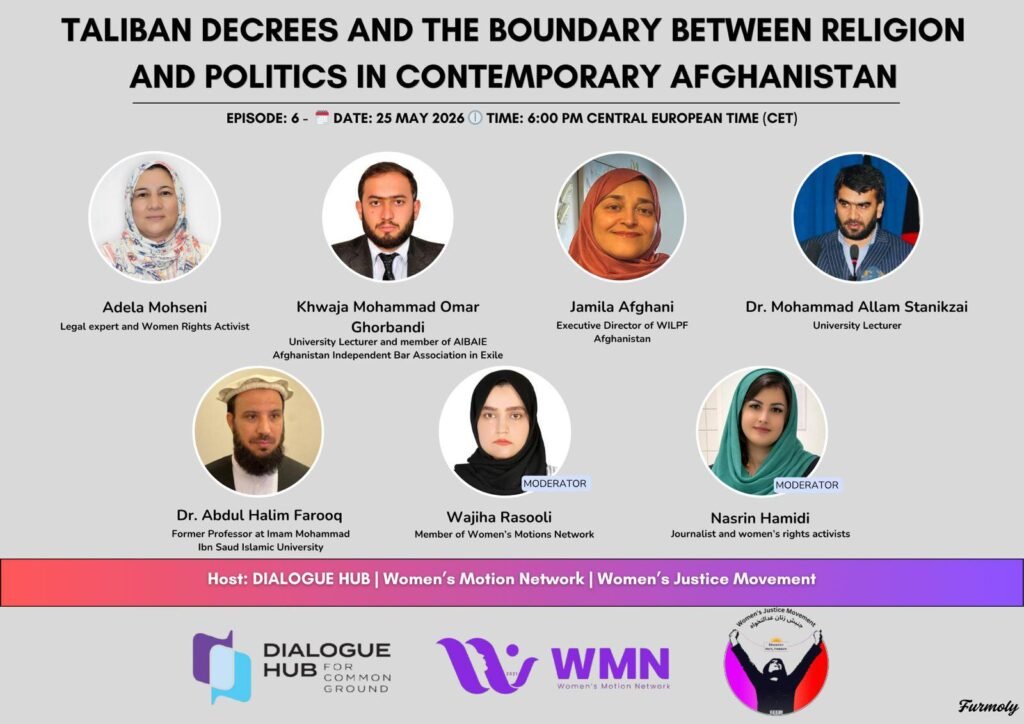
This policy brief is based on a multi-speaker X (Twitter) Spaces discussion held on 25 May 2023 titled “The Boundary Between Religion and Politics in Afghanistan.” The discussion brought together legal scholars, academics, and human rights advocates to examine the relationship between religion, law, and governance under the current de facto authorities in Afghanistan.
A key theme emerging from the discussion is that the de facto authorities frequently justify political and legal decisions using religious references. Multiple legal and academic contributors in the dialogue challenged this approach, arguing that many such policies reflect political interpretation rather than universally agreed Islamic jurisprudence. They further emphasized that Islamic law is diverse and interpretive, and cannot be reduced to a single political narrative.
Participants expressed concern that the use of religion as a primary justification for governance decisions risks weakening legal institutions, undermining judicial independence, and restricting fundamental rights, particularly for women and vulnerable groups. Issues highlighted included access to education, legal representation, due process, and institutional independence.
The discussion also noted that several restrictions imposed in Afghanistan are framed as religious obligations by the authorities, while scholars and experts in the conversation argued that such framing does not necessarily reflect consensus within Islamic legal traditions. In this sense, the discussion highlighted a clear tension between political authority and religious interpretation, with concerns raised about the potential instrumentalization of religion for political legitimacy.
Overall, the dialogue reflects a pluralistic and contested intellectual environment, rather than a single unified position on the relationship between Islam, law, and governance in Afghanistan.
1. Background
Since August 2021, Afghanistan has experienced significant changes in governance structures, legal frameworks, and institutional arrangements. The role of formal constitutional order has been replaced by de facto governance practices, with increasing reliance on executive decrees and religious justification for legal and administrative decisions.
In this context, public digital forums such as X Spaces have become important spaces for debate among Afghan scholars, activists, and professionals regarding:
- The role of Islamic jurisprudence in state governance
- The legitimacy of executive decrees
- The status of legal institutions and judicial independence
- The impact of governance decisions on human rights
The referenced discussion reflects these broader dynamics.
2. Key Issues Raised in the Discussion
2.1 Use of Religious Justification in Governance
Participants noted that many policies are publicly justified through religious references. Concerns were raised regarding:
- The authority to interpret religious texts in state policy
- The distinction between religious jurisprudence and political decision-making
- The absence of pluralistic interpretive processes
2.2 Institutional and Legal Framework Concerns
Speakers highlighted perceived weakening of legal institutions, including:
- Reduced independence of legal professionals and bar associations
- Limitations on due process and fair trial guarantees
- Constraints on legal representation and defense rights
2.3 Rights and Social Impact
A significant portion of the discussion focused on the impact of current policies on:
- Women’s education and mobility
- Family law and access to legal remedies
- Broader civil and political rights
2.4 Diversity of Islamic Legal Interpretation
Participants emphasized that:
- Islamic jurisprudence is diverse and multi-school in nature
- No single political authority can claim exclusive religious interpretation
- Legal and theological disagreement exists within Islamic scholarship
3. Diverging Perspectives
The discussion included multiple perspectives:
- Legal and academic perspectives emphasizing rule of law, institutional governance, and constitutional principles
- Religious perspectives emphasizing Sharia as a foundational reference, while differing on interpretation and application
- Human rights perspectives emphasizing equality, access to education, and protection of fundamental freedoms
No unified conclusion emerged, reflecting the complexity of the subject matter.
4. Policy Implications
4.1 Governance Legitimacy
The use of religious justification for governance decisions may:
- Increase domestic acceptance among some constituencies
- Create tensions with international legal and human rights frameworks
4.2 Rule of Law
Weak institutional frameworks may result in:
- Reduced access to justice
- Limited legal accountability mechanisms
- Increased discretionary governance
4.3 Human Rights Concerns
Restrictions affecting education, legal access, and civil participation may:
- Contribute to long-term structural inequality
- Undermine compliance with international human rights obligations
4.4 Religious Interpretation and Political Authority
The merging of political authority with religious interpretation may:
- Create contestation over religious legitimacy
- Increase polarization within religious and legal communities
5. Key Analytical Observation
A central analytical point emerging from the discussion is that the distinction between religion as a moral-ethical framework and its use as a tool of political governance is critical for understanding current developments in Afghanistan.
Several participants emphasized that religious claims used in political decision-making should remain open to scholarly review, legal analysis, and ethical scrutiny.
6. Recommendations
To de facto authorities and national stakeholders
- Encourage structured engagement between legal scholars and religious scholars on governance and lawmaking
- Strengthen transparent and pluralistic interpretive mechanisms for legal and religious questions
- Reassess policies that restrict access to education and legal representation in light of broader Islamic jurisprudential diversity
To international organizations and policy actors
- Support independent monitoring and documentation of legal and institutional developments
- Engage with a diversity of Afghan scholarly and civil society voices
- Prioritize protection of access to justice, legal identity, and basic civil rights
To academic and civil society actors
- Promote interdisciplinary dialogue on law, religion, and governance
- Document civic digital debates as part of contemporary governance analysis
- Support legal literacy and rights awareness initiatives
Conclusion
The X Spaces discussion highlights ongoing tensions in Afghanistan regarding the relationship between religion, law, and political authority. Rather than presenting a single narrative, it reflects a contested environment in which legitimacy, governance, and rights are continuously negotiated among competing legal, religious, and political interpretations.