Art code: A-001
Fractured Selves
Artist: Negah Jalali
Origin: Shighnan, Badakhshan, Afghanistan
Born: 2000
Medium: Mixed-media collage
Size: 50 × 60 cm
Price: €200
Member: Artists Committee, Dialogue Hub for Common Ground
About the Artist
Negah Jalali, born in 2000 in Shighnan, Badakhshan, is an Afghan artist whose work emerges from a reality shaped by loss, repression, and the struggle to preserve identity.
Negah lost her father during the first period of Taliban rule. Today, she continues to live under Taliban rule in Afghanistan, where she paints discreetly and away from public view. As a member of the Artists Committee of Dialogue Hub for Common Ground, her art becomes a quiet but powerful form of expression in a context where freedom of expression, particularly for women, remains severely restricted.
About the Artwork
Fractured Selves is a black-and-white collage about survival and the painful transformation of identity under repression.
The work tells the story of a prominent former female journalist who, to survive the relentless scrutiny of the moral police, was forced to erase the person she once was. She burned her old press credentials, changed her appearance, concealed her identity, and disappeared into the shadows.
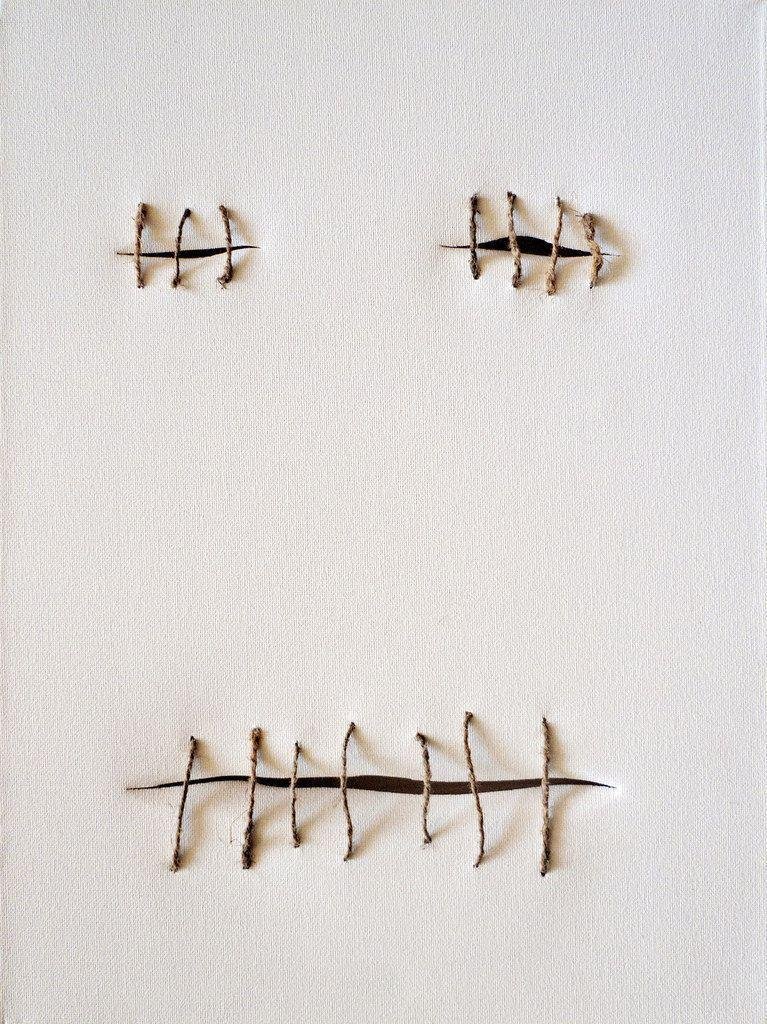
In the collage, the body itself becomes a metaphor for this psychological violence. The mouth, hand, heart, and mind appear torn apart, as though the self must be physically dismantled to become acceptable to an oppressive society. Rough, frantic threads then attempt to stitch these broken pieces back together, creating a version of the self shaped by the demands of survival.
The artwork asks a painful question: How much of ourselves can we be forced to surrender simply to remain alive?
Message
Trauma and repression can force people to fracture themselves, hiding their voices, altering their identities, and separating parts of who they are in order to survive.
Yet healing requires more than survival. It requires finding and reconnecting the pieces that were torn apart: our voice, our heart, our mind, and our sense of self.
Fractured Selves is therefore not only a story of brokenness. It is also a story of resistance, memory, and the possibility of becoming whole again.
By supporting this artwork, you are supporting an Afghan artist who continues to create and express herself despite the restrictions and risks surrounding her.
Art code: A-002
Lineage of Constraints
Artist: Mohammad
Year: 2024
Medium: Mixed Media
Dimensions: 60 × 50 cm
Price: €200
Origin: Baghlan, Afghanistan
About the Artwork
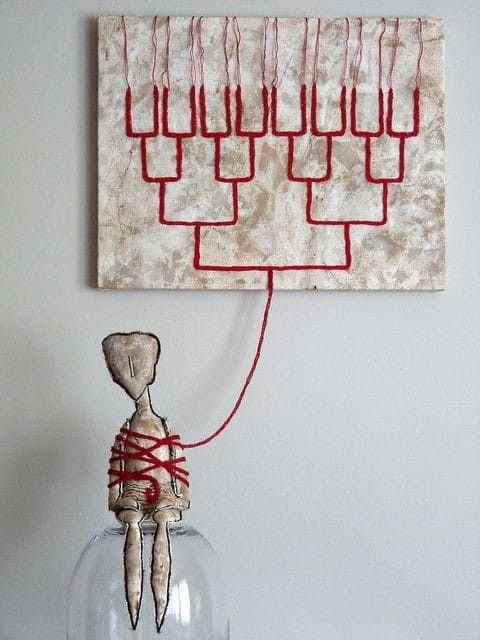
Lineage of Constraints tells the story of a young Afghan woman facing forced marriage, a reality that has become increasingly prevalent as families have lost livelihoods and economic security.
At the centre of the work, a small and fragile fabric figure sits precariously on an inverted glass jar, isolated, trapped, and controlled. Above her, a complex family tree represents the strict family structures and social codes shaped by generations of patriarchal traditions. Blood-red thread traces the branches of this lineage before descending into a single line that transforms into a literal leash around the figure below.
The work explores how trauma, social expectations, and structural limitations can be inherited across generations. The family tree becomes more than a symbol of ancestry: it becomes a structure of control, showing how individuals can find themselves bound by histories, traditions, and choices made long before they were born.
About the Artist
Mohammad is an artist from Baghlan Province, Afghanistan and a former Afghan soldier. His artistic practice reflects experiences of conflict, displacement, social restrictions, and the lived realities of Afghan communities.
Due to the current security situation in Afghanistan, Mohammad continues to live and work in secrecy under Taliban rule. His identity and circumstances remain sensitive, making his artistic work not only a form of creative expression but also an act of documenting experiences that are often difficult or dangerous to speak about openly.
Through his work, Mohammad explores the intersection of personal experience and broader social realities, giving visual form to stories of constraint, vulnerability, resilience, and survival.
Silenced Heritage
Art code: A-003
Artist: Panah Shughnani
Year: 2025
Medium: Mixed Media
Dimensions: 50 × 60 cm
Price: €200
About the Artwork
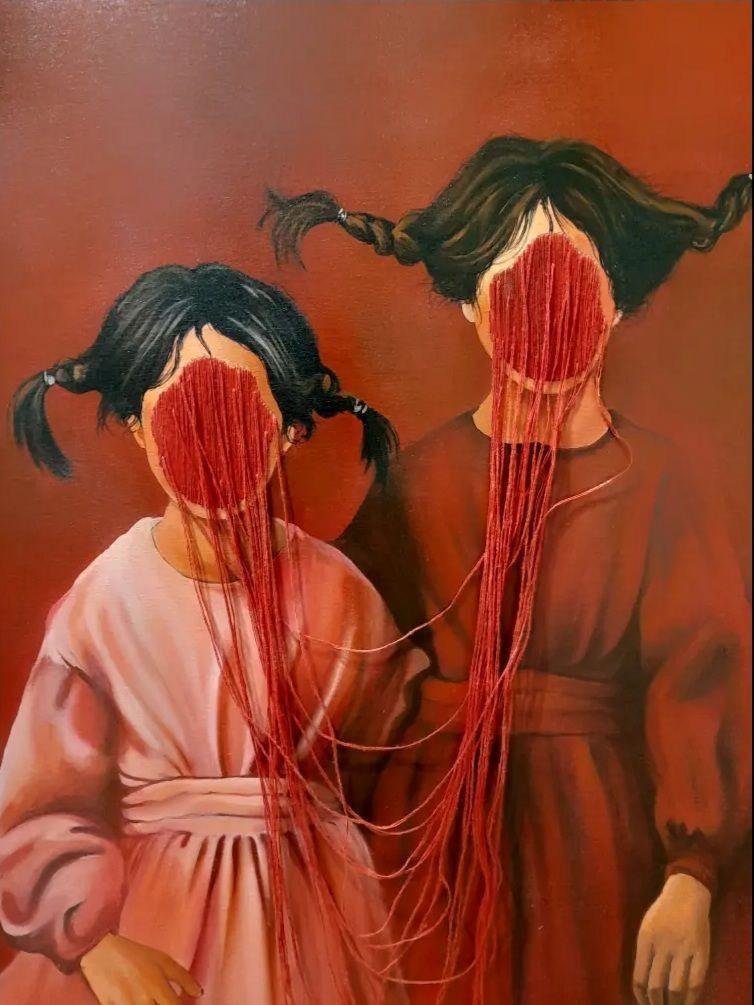
Silenced Heritage captures the psychological weight of a moment of profound loss: two sisters standing in their home as their mother packs away their colorful dresses, following restrictions that prohibit women’s voices from being heard in public.
The girls’ faces are completely erased, replaced by heavy strands of cascading red yarn that flow down across their bodies. The red yarn symbolizes a forced collective identity, representing how individuality, expression, and personal identity are unraveled and woven into a single, uniform wall of silence.
The painting reflects not only the suppression of two young women, but the broader impact of restrictive laws on generations. Their erased faces suggest the removal of identity, while the tangled red threads evoke the emotional and psychological consequences of being denied the freedom to speak, express, and exist openly.
Message
Suppression does not silence only one individual; it can bleed across generations. When identity and freedom of expression are erased, the collective voice gradually unravels into a painful, shared silence.
Silenced Heritage is a reflection on identity, inherited trauma, gender-based restrictions, and the resilience of women and girls whose voices continue to exist even when they are denied the right to be heard.
About the Artist
Panah Shughnani is an Afghan artist whose work explores identity, memory, gender, social restrictions, and the lived realities of communities affected by conflict and repression. Through symbolic materials and powerful visual language, Shughnani reflects on the ways political and social restrictions shape individual lives and are carried across generations.
Reflections of the Severed
Art code: A-004
Artist: Mohammad
Year: 2023
Medium: Mixed Media
Dimensions: 50 × 60 cm
Price: €200
About the Artwork
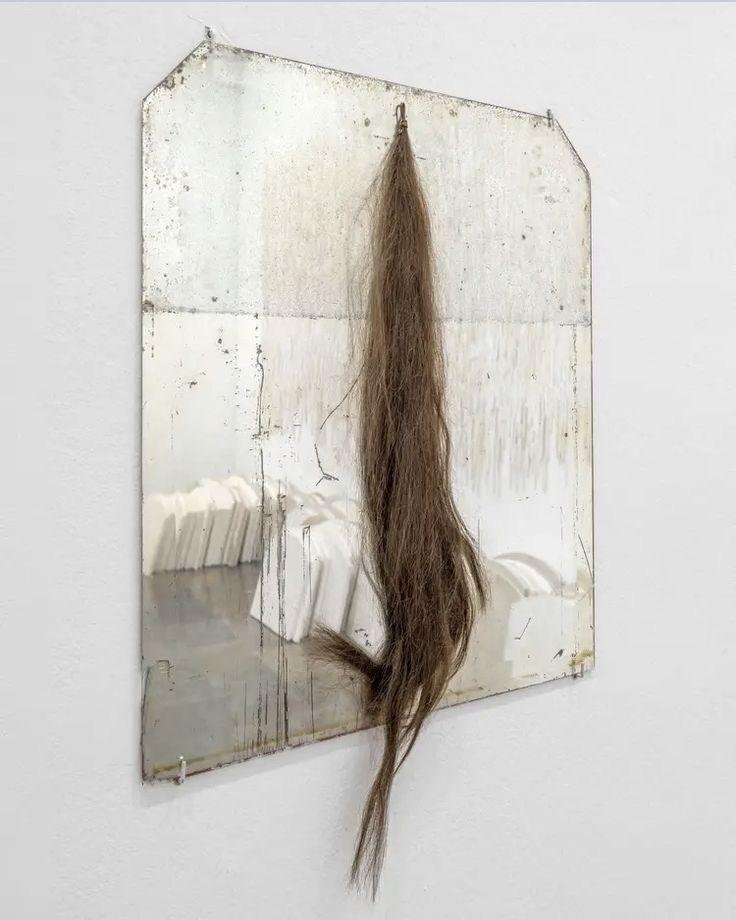
Reflections of the Severed tells the story of a young woman whose sister is arrested during a street protest. In an act of mourning and defiance rooted in an ancient traditional ritual, she cuts off her long hair and hangs the severed braid over an old, decaying mirror in her hallway.
The mirror becomes more than an object of daily self-reflection. In its reflection, the woman’s face is obscured by the absence and loss of her sister. The long braid hanging against the cold glass becomes a haunting monument to a life violently interrupted, transforming an ordinary household object into a permanent reminder of grief, resistance, and loss.
Message
The work explores how what we leave behind, and what is forcibly taken from us, can continue to shape and haunt our personal histories.
The severed hair symbolizes both loss and resistance, while the empty and obscured reflection suggests how the loss of autonomy can fundamentally alter the way we see ourselves and how the world sees us. The mirror no longer reflects identity alone; it reflects grief, absence, and the lasting consequences of repression.
The Weight of the Anchor
Art code_ A-005
Artist: Nazifa Jalali
Year: 2021
Medium: Installation / Mixed Media
Dimensions: 70 × 100 cm
Price: €300
About the Artwork
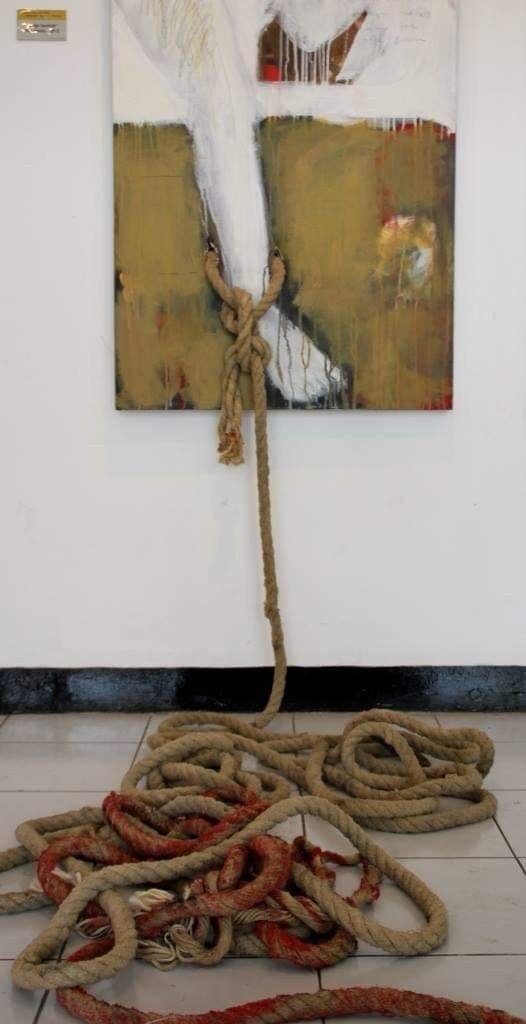
The Weight of the Anchor explores the struggle of an artist attempting to flee across a border in search of safety and the freedom to continue creating.
At the centre of the work, a painted white leg reaches forward into an open space, representing movement, possibility, and the hope of a future beyond confinement. Yet the artwork does not remain within the boundaries of the canvas. A massive, blood-stained rope physically emerges into the surrounding space and is tied tightly around the ankle.
The rope becomes a literal anchor. It represents the accumulated weight of humanitarian crisis, economic collapse, violence, and the bloodshed left behind in the artist’s homeland. No matter how strongly the figure reaches toward freedom, the burdens of the past continue to pull her back.
By extending the painted image into physical space, the installation challenges the boundary between art and reality. What begins as an image of movement becomes a tangible experience of being restrained.
Message
Art has the power to move beyond the canvas and enter the reality of our lives. Yet freedom is rarely experienced without the weight of what we carry with us.
The blood-stained rope represents the painful burdens of conflict, displacement, economic hardship, and collective trauma. The work embodies the struggle to move forward while the consequences of the past continue to hold us in place.
The anchor is not simply a symbol of captivity. It is also a reminder that the past remains physically and emotionally present, even when we are trying to build a different future.
About the Artist
Nazifa Jalali is an Afghan human rights advocate, researcher, and civil society leader based in Norway. She is the Founder and Director of Dialogue Hub for Common Ground, an organisation working to document human rights violations, amplify marginalized voices, and strengthen advocacy and international dialogue on Afghanistan. The organisation’s work focuses on human rights documentation, women’s and minority rights, civic space, accountability, and inclusive engagement.
Jalali has been actively engaged in international advocacy and Afghan civil society initiatives, including dialogues and policy discussions with international actors. Her work brings together documentation, advocacy, dialogue, and lived experience to create greater visibility for communities affected by conflict and repression.
In her artistic practice, Jalali uses symbolism and installation to explore displacement, freedom, identity, conflict, and the psychological weight carried by individuals and communities affected by violence. The Weight of the Anchor reflects this intersection between personal expression and the wider realities of Afghanistan.
The Confined Gaze
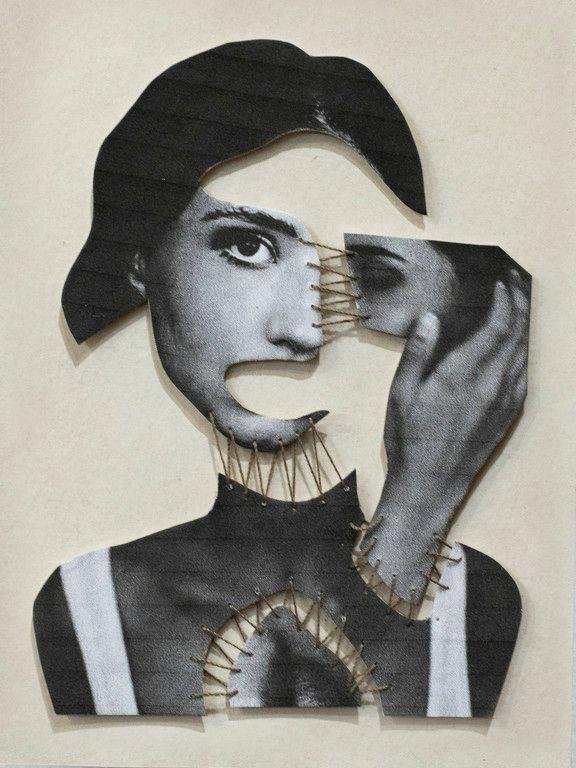
Sutured Expression
Art Code: A-007
¨Artist: Neelam Ali
Year: 2026
Medium: Mixed Media
Dimensions: 50 × 60 cm
Price: €200
About the Artwork
Sutured Expression confronts the violence of forced compliance and censorship through a deeply physical visual metaphor.
The work portrays a figure whose eyes and mouth have been forcibly stitched closed. The stitches represent more than physical restraint. They symbolize the systematic suppression of perception, expression, truth, and the ability to communicate freely.
By transforming censorship into a visible wound, the artwork draws attention to the psychological and emotional scars created when individuals are denied the freedom to see, speak, question, and express themselves. The human body becomes a site of control, where silence is imposed through violence rather than chosen freely.
Message
Forced compliance and censorship leave deep and lasting scars.
Stitching over a person’s eyes and mouth becomes a brutal attempt to strip away their ability to perceive, speak, and communicate their truth. The work reflects how repression can turn human communication into a painful form of confinement, while reminding us that silencing a voice does not erase the truth it carries.
About the Artist
Neelam Ali is an Afghan artist whose work explores themes of freedom, identity, censorship, repression, and the lived experiences of individuals affected by social and political restrictions.
Through powerful symbolic imagery and mixed-media techniques, Ali examines the ways in which external forces can attempt to control the body, voice, and identity of individuals. Her practice gives visual form to experiences of silencing and resistance, using the human figure as a powerful space through which questions of dignity, autonomy, and freedom can be explored.
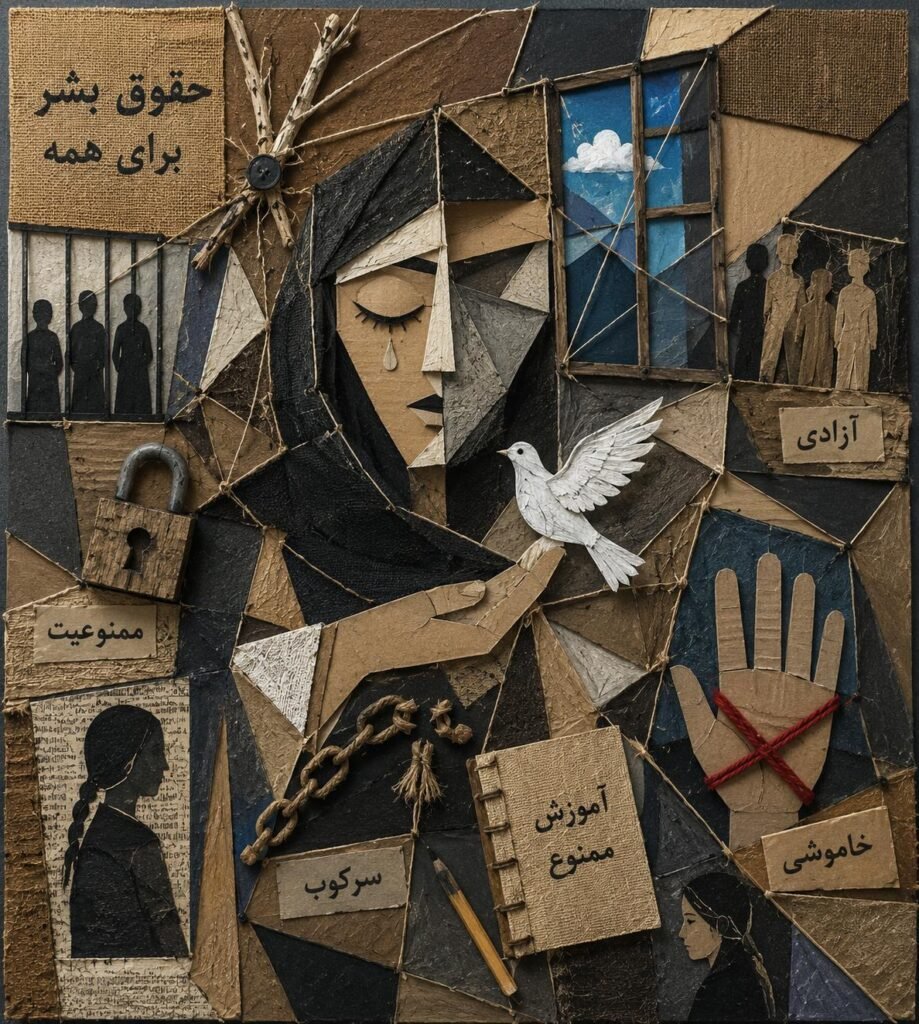
Human Rights for All
Art code: A-008
Artist: Nazifa Jalali
Year: 2024
Medium: Mixed Media Collage
Dimensions: 50 × 60 cm
Price: €250
About the Artwork
Human Rights for All is a complex mixed-media collage that takes the form of a protest banner assembled from fragments of cardboard and newspaper gathered from an abandoned classroom.
At its centre is the image of a female student whose notebook has been closed and marked with the words “Education is Forbidden,” placed beside a broken pencil. The imagery documents the direct loss of fundamental freedoms, particularly the right to education and freedom of expression.
A white dove rests in the student’s palm, representing peace and the hope for a different future. Yet that hope exists within a fractured reality. A heavy lock seals the space where her peers are confined, while a blood-red “X” is stitched across the hand reaching toward the promise of “Freedom.”
The use of discarded classroom materials transforms the artwork itself into an act of testimony. Objects associated with learning become fragments of evidence, carrying the traces of a generation whose access to education and basic rights has been deliberately restricted.
Message
Human Rights for All is a protest against oppression, censorship, and the systematic erosion of fundamental human liberties.
The work asks what peace and freedom can truly mean when education is denied, hands are bound, and innocent voices are silenced. The broken pencil, locked space, and wounded hand become symbols of rights interrupted and futures deliberately constrained.
The white dove remains a quiet symbol of hope, suggesting that the desire for dignity, education, freedom, and peace persists even under conditions of repression.
About the Artist
Nazifa Jalali is an Afghan human rights advocate, researcher, artist, and civil society leader. She is the Co-Founder and Director of Dialogue Hub for Common Ground, an organisation working on human rights documentation, inclusion, advocacy, dialogue, and the amplification of marginalized voices in Afghanistan and beyond.
Her artistic practice explores the intersection of human rights, conflict, displacement, identity, gender, and freedom. Through mixed media, symbolism, and the incorporation of everyday or discarded materials, Jalali transforms social and political realities into visual narratives.
Her work reflects a commitment to documenting experiences that are often excluded from official narratives, while using art as a space for testimony, resistance, and reflection.